Showing posts with label The Basics. Show all posts

28 June, 2023

Eclectic Gardening!


Want your eclectic streak to run wild in the garden?

Do you have a strong desire to grow all types of plants from all sorts of different origins?

You really don’t have to settle on one uniform theme for your entire garden, if you want a tropical paradise, a desert oasis and a Mediterranean cottage garden at your place, then you absolutely can! And although all three of these garden themes require different conditions – Soil, water, sunlight – You can utilise the different micro-climates that your property has to offer and even create some new ones to grow almost any plant your heart desires.    


Natural and Artificial Micro-Climates

Don’t let the climate zone you reside in dictate what plants you can work with, as you will find your property will have  a couple of different micro-climates naturally on its own:

- One area might be shady and cool thanks to large trees or buildings casting shadows.

- Another area might be protected nicely from winds by fences, walls, and trees.

- One might be suited to heat-loving plants due to masonry paving, rocks, boulders or walls.

- Slopes and hills offer a drainage difference from the top to the bottom which can be used to your advantage.

On top of that, you can create your own micro-climate to suit the plants you wish to grow:

- Planting lawn will have a cooling effect on its surrounds.

- Bodies of water can help balance out extreme weather - They can help keep an area cooler in the heat, more humid in dry conditions and warmer in frost prone areas.

- Mass planting gives individual plants a buddy or two, so they don’t have to fight those tough conditions all on their own.


Container Gardening

Pots and containers are the easiest and most efficient way to combine several themes and types of plants into your garden. Think of each pot as its own garden bed. Each container can have its own soil type and its own watering needs without having to take into consideration its neighbouring pots. Unlike a static garden bed, a pot can be moved around from season to season so it can always be in its ideal position. They come in so many styles, shapes, heights and colours, and you can bunch a group of pots together in one particular spot to create a grand, lush, eye catching display. 


Raised garden beds

Want the grand appeal of a garden but with the convenience of container gardening, then raised garden beds are the ideal choice. Let’s say you had a desire to combine cacti into your already established garden that has water hungry plants, like flowering perennials. In order to achieve this, you can simply raise a section of the garden with a prebuilt raised garden bed, or rusted metal garden edging. In this section, you can fill it with well-draining, sandy soil that cacti will love. The added height will help with the drainage, and you can easily water lower levels more often without overwatering the cacti above.


Use of props

You are by no means limited to an ordinary pot or container - You can use just about anything! An old wheelbarrow, for example, makes a great display. A couple of large boulders placed together that can retain some soil can also do the trick. A wine barrel, a retired bath tub, even an old tire can be planted into. Just make sure that holes are drilled for drainage and you are good to go. 

Adding sculptures, pillars, or any kind of garden art not only gives the space a point of interest, it can also help to retain heat during the cooler weather, or provide shade in the heat of summer. A dining chair, garden bench or small stool can be used as stands to place pots on when creating grouped container garden displays. Wooden props can be sealed to protect them from rotting, and metal props when exposed to the weather look all the more charming.


11 April, 2022

How much light do Succulents really need? Part 2 of 2 – Too Much Light??


How much light do succulents need? Part 2 – Is there such a thing as too much light?

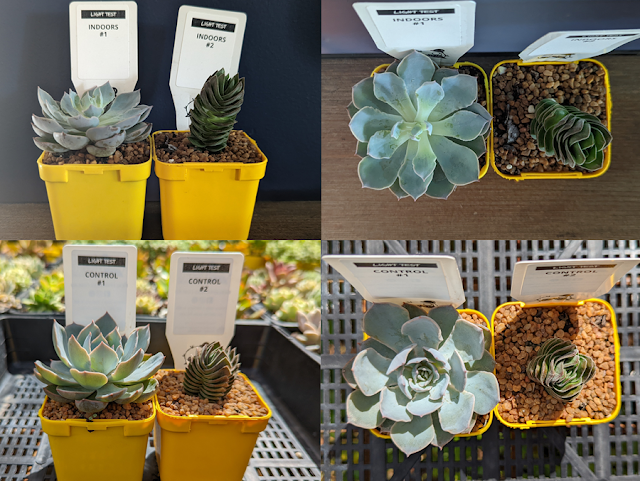
I recently conducted an experiment keeping succulents under various light conditions. 3 identical sets of plants, one set kept in a dark room, one under some artificial grow lights, and one grown as a control in the stable conditions of our succulent nursery. The purpose of the experiment was to provide some side by side photos in order to help point people in the right direction about finding the ideal spot at home to grow succulents.

In part 1 of this story, I discussed the results of the plants grown in a dark room. After 7 days, the succulents starting showing signs of lack of light and by day 12 they looked quite light deprived compared to the control plants. If you would like to view the results of that comparison, and see some tips on how to rectify the symptoms of lack of light in succulents, please head to Part 1: Signs of Lack of Light.

In part 2, I want to talk about the plants I kept under artificial grow lights. Now, I chose to add this to the experiment, because keeping succulents in an indoor location can be impractical if they don’t receive enough light in that room. By adding a grow light to your indoor succulents, you can supplement that indirect light it receives thorough a window, and you can successfully keep a nice, healthy compact plant indoors.

But for how long each day should you have this grow light on for? This is the question I wanted to answer by placing these plants under these lights. And thus, the experiment continues!

Now, if you would like to get into the science of how grow lights work, including the light spectrum, different wavelengths/colours, LED vs incandescent, it’s a big subject you can really sink your teeth into, and I do recommend delving into that rabbit hole if you have time. However for this experiment, I’m keeping it simple – I actually used an aquarium light passed on to me from my partner who really likes to keep fish. I confess, it’s a rather cheap light. I don’t have too many specs on it, only that it is 24w LED, and they are white coloured LED’s. I’ve germinated seeds under this light before and I’m very happy with the results.


THE EXPERIMENT

The Plants

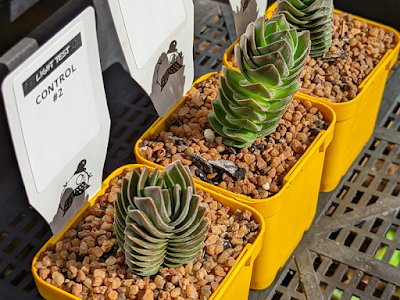
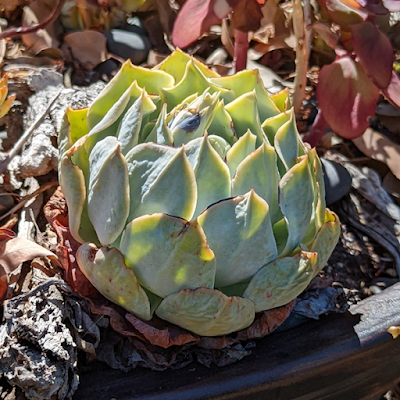
Just as a reminder, the succulents I chose for this experiment were ‘Echeveria Morning Beauty’ and Crassula ‘Buddah’s Temple’. I chose the Morning Beauty because of its bright blue colour, and for its rosette shape, the Buddah’s Temple I chose because its deep green colour, and its upright growth habit.


The Conditions

All the plants were from the same batches – They were the same age, same potting media, same pot size, and had the same watering schedule up until the start of the experiment.

The control plants in this experiment were placed out in the nursery, and they received about 8 hours of sunlight per day. They were under hail net which filters out a small fraction of light. They were watered every day, as I conducted this experiment at the end of summer.

The indoor plants were kept in a room I know to be too dark to grow succulents. Although next to a window, the indirect light was just too filtered to be sufficient for healthy growth. They were watered every second or third day.

The grow light plants were placed inside a glass tank, with the LED bar light about 25cm above them. They were watered every second or third day.

I kept this light on in this tank for 24 hours a day for the duration of this experiment.

The reason why? To see whether there is such a thing as ‘too much light’.  I’ve read up on the idea of light toxicity and the detrimental effect  it can have on plants, and Kaye tells me it does exist (She is the horticulturalist in the family, who am I to disagree…) BUT, I just really wanted to see the results for myself.


THE RESULTS

Day 1


Day 3


Day 7


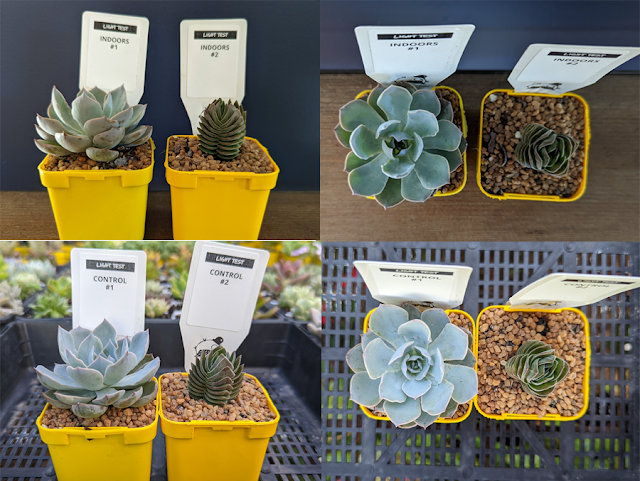
By day 7 there still weren’t too many differences in the plants – All 4 plants were very healthy. In fact, the Morning Beauty under the 24 hour light was doing far better than I could have expected. The foliage was strong and the rosette nice and compact. No signs of light toxicity at all.

Day 12


It was by Day 12 that I was really impressed. Both plants under the 24 hour light were absolutely thriving. The blue colour in the Morning Beauty was so intense.

Day 15 – The final Comparison


Wow. Very unexpected results. Putting all 6 plants in this experiment side by side to compare made the results very clear. No light toxicity to be seen! The intense blue colour in the Morning Beauty kept under the grow lights is just stunning. The Buddah’s Temple faired well too, however the control is just a tad more sun hardened, you can see that by the bronze colour it shows.

So, if you have succulents you wish to place indoors, in a spot that may be a tad too dark for healthy growth, definitely think about using a grow light. As for how long to keep the light on for each day, I would start at the basic 8 hours of light per day to mimic the sun’s behaviour. You can always increase of decrease it based on the look of your plants. Timers work great so you don’t have to remember to switch them on every day, and I like to offset the 8 hours and run my lights from noon to 8pm, so I can enjoy seeing my succulents all lit up in the evening.


Read Part 1 of this Experiment, How much light do Succulents really need? Part 1 of 2 – Lack of Light


16 March, 2022

How much light do Succulents really need? Part 1 of 2 – Lack of Light

How much light do Succulents need?

How much light do Succulents really need?

It’s a question that is asked quite often, and unfortunately, there is no universal, one size fits all answer. Succulents are a family of plants that originate from all around the globe, from all different types of environments - Tropical, Arid and even Alpine. It’s what makes them so fascinating to grow, as they offer so many different colours, textures and shapes.

The best approach in narrowing down what your succulent may need in terms of light, is to research what area it originates from, and replicating that at home. In combination with that, my best advice is to simply keep an eye on your succulent. If it is showing signs of lack of light, it’s time to make some adjustments.


What are the signs of lack of light in succulents?

To answer this question, at first I wanted to put some succulents in a dark room and take some photos after a week or two to highlight the visual signs of lack of light. Then I thought I should have some ‘control’ plants grown out in our nursery to offer as a comparison. THEN, I took it one step further and added to the experiment some plants grown under artificial grow lights, and you can read all about that in part two of this article coming up next month.


THE EXPERIMENT

The Plants

The succulents I have chosen for this experiment are ‘Echeveria Morning Beauty’ and Crassula ‘Buddah’s Temple’. I chose the Morning Beauty because of its bright blue colour, and for its rosette shape, the Buddah’s Temple I chose because its deep green colour, and its upright growth habit. 


The Conditions

All the plants are from the same batches – They are the same age, same potting media, same pot size, and have had the same watering schedule up until now.

The control plants in this experiment will be placed out in the nursery, and they receive about 8 hours of sunlight per day. They are under hail net which filters out a small fraction of light. They are watered every day, as it is the end of summer.

The indoor plants will be in my living room – A room I know to be too dark to grow succulents. Placed on a side table near a window, you may think that would be sufficient, however on the outside of the window is a rather deep undercover area. So, although there is some light coming in, it is not enough to promote healthy growth (except for my ZZ plant, which I’m pretty sure grows on magic pixy dust and not light, because it is absolutely thriving in that room!). As for watering they will be watered every second or third day, when they start looking a little dry.


THE RESULTS
Day 1

Day 1 - Lack of lIght Experiment


Day 3

Day 3 - Lack of light Experiment


Day 7

Day 7 - Lack of light Experiment


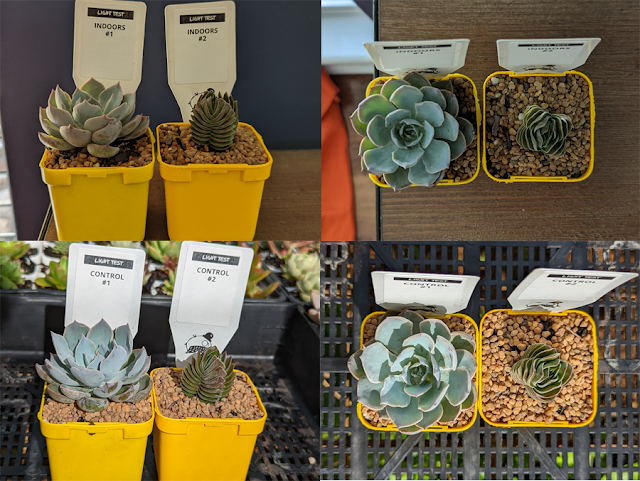
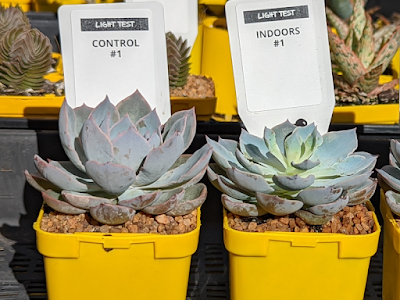
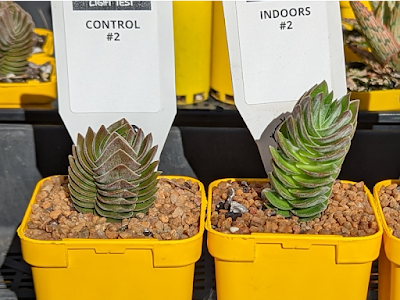
On day 7 you can see that the indoor Echeveria is starting to lose its colour towards the centre of the rosette. The Crassula is growing a little elongated as it reaches for light, and It is also starting to get a little pale in colour.


Day 12

Day 12 - Lack of light Experiment


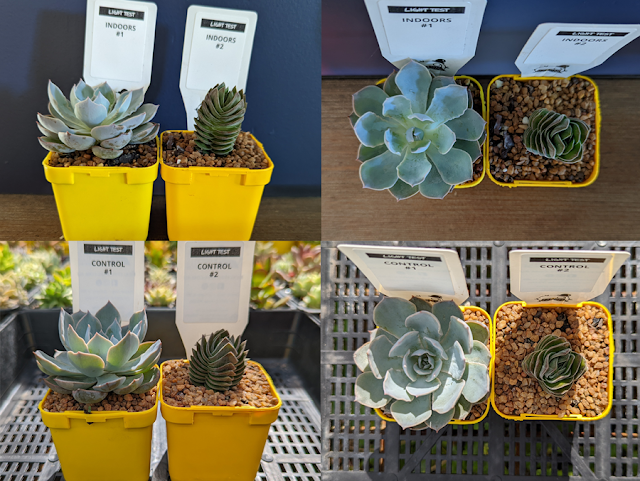
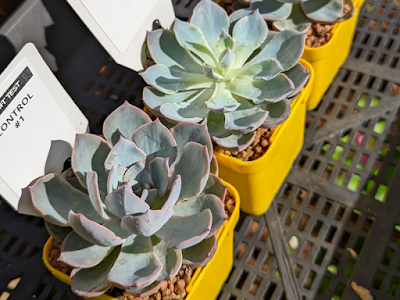
By day 12 the Echeveria has lost more colour from the centre, and is flattening its shape compared to the control. The Crassula is much taller than the control now, and you can start to see the leaves flattening out, similar to the Echeveria.  The leaves on the control Crassula by comparison remain nice and compact.


Day 15 – The Final Comparison

Day 15 - Lack of light Experiment

Day 15 - Lack of light Experiment

Day 15 - Lack of light Experiment

Day 15 - Lack of light Experiment


As you can see, the differences are quite stark side by side on day 15, the last day of the experiment. The Crassula fared much better indoors than the Echeveria, and that’s due to its green colour which makes it more tolerant of low light conditions.


Signs of lack of light to watch out for:

Lack of colour in the foliage
Elongated growth
Flattening of rosettes or the separation of leaves
Leaves becoming soft, and sponge-like.


What can I do about it?

If you start seeing these signs in your succulents, it may be time to relocate them. You can give them the best chance to get healthy again with a few simple tips:

1. Try not to put them into a bright sunny position straight away, as this can shock them and they will go downhill quite quickly. A gradual introduction of more light is the way to go. 

2. Avoid watering too often during this period – This especially applies to rosette types, as an intake of too much water could cause them to rot.

3. Don’t fertilise a sick plant – This generally applies to most plants, not just succulents. Wait until you see some fresh healthy growth to apply a fertiliser.

4. Prune if you can – This applies to upright types, if you cut back the elongated growth, new growth will shoot away and you should start to see a nice compact plant.

5. In the case of the Echeveria, it may be too far gone to save that one rosette, BUT you may find that it will pup because it is in a stressed state. Those pups will send down roots and grow to fill up the pot space.


I hope this article points you in the right direction about finding the ideal spot in your home to grow succulents. Hopefully it will help you identify signs of lack of light, and what you can do to help them out.  In our next newsletter, we will have part 2 of this experiment, which deals with the idea of ‘too much light’, as well as growing succulents under artificial grow lights.


Read Part 2 of this experiment: How much light do succulents need? Part 2 – Is there such a thing as too much light?


18 January, 2022

Succulent in Heatwaves - Top Questions Answered


It seems that summer has now officially arrived, albeit a little late to the party.

The mild start to the season was a delightful treat to everyone and their plants. Then, it seemed without notice, we were blasted into the high 30's and low 40's before we knew it - A lovely Christmas present to us all.

Up in the hills here, we actually lost power for two days over Christmas. This meant our reticulation system was out for the count and we were forced to halt the celebrations to hand water our plants. Oh, the sacrifices we make for the plants!

How did your succulents fair in the heat wave? Are you prepared for the next one?

As we head into the second month of summer (and it seems like the hot weather is here to stay), we thought we would answer some frequently asked questions we are receiving lately about caring for succulents in the heat.


How often should I water during Summer?

One old fashioned rule is to 'water when the soil or mix becomes dry'. I'm not the biggest fan of this rule, as you don't actually want the soil or mix to completely dry out - This will make it become water repellant. When you do get around to watering, the water will sit on top of the soil/mix for a second or two, and then run off to the side, away from the base and roots of the plant. 

If this is the case with your mix, don't fret, it can be corrected - You can use a soil wetting agent to improve water penetration. They come in liquid form and a granular form ( I prefer the granules, you can sprinkle over as needed with ease).

A more modern take on this watering guidline is 'Water when the soil or mix is NEARLY dry'. A little less than damp. But how often is that?

Well, it does depend on a bunch of different factors - Plants inside will need watering less often, as will those in shadier positions in the garden. On the other hand, those plants in pots (especially smaller ones) could be watered once a day in the summer months, as could plants in sunnier positions. Learn to listen to your plants, and look for the signs of dehydration - Wilted or sagging leaves, rosettes shrinking and closing up, loss of colour and brown leaves.

An Echeveria 'Domingo' with heat stress.

An Echeveria 'Domingo' showing signs of heat stress - the rosette has closed up and the leaves are wrinkled and turning brown.

Aloe striata showing heat stress

An Aloe striata in the garden that is suffering in the heat. The rosette has closed up and the leaves are browning and curling.


How can I stop leaves from burning?

There are a few temporary measures you can take to help protect your succulents from burning in the sun if you know the temperature is going to go up past, say, 38 (ish) degrees.

The first is temporary relocation - If your plants are in pots, and you are able to move them, the best option is to place them somewhere for the day, or a couple of days, where the sunlight isn't shining directly on them. Under a verandah or patio is perfect. Ideally, somewhere where they can still receive plenty of indirect sunlight.

The second option is a temporary shade sail, such as shade cloth. The key to creating a great temporary shade sail is airflow. Lift the shade cloth up with stakes as much as you can and avoid having the shade cloth touching the foliage. If it's quite low to the ground, it can create an environment too humid for succulents.

After a couple of days of being under shade cloth, your succulents can start to become leggy and green, so it's not really an ideal situation for the whole summer season, but the perfect temporary solution for those extreme days.


When should I water my succulents?

If possible, try to water your succulents in the cooler times of the day - Either early in the morning or late afternoon. The reason for this is that it can be the combination of water and heat that causes rot in your plants. Sometimes the water can pool on the foliage, especially in the case of rosette type succulents. This pooling creates a 'magnifying glass effect' with the sunlight, which can cause sun damage.

Remember to water succulents thoroughly, so they can develop a lovely strong, deep, root system. This gives them the best chance to defend themselves against the heat.


For the most part, succulents are very water wise, and generally very tolerant of the heat. But during those times where temperatures start getting above 36/38, and especially for an extended period of time, we need to provide them with just a little more TLC so they can get through the season.

05 June, 2019

Keeping Succulents Indoors - A How-to Guide


Choosing Plants:
Opt for succulents that can tolerate low light conditions. Green coloured succulents tend to be low-light tolerant, and are more successfully grown indoors. Succulents with bold, bright colours tend to require more light than an indoor position can offer. These succulents are better suited to outdoor applications in a full sun/part shade aspect.

Haworthia and Gasteria species make fabulous indoor succulents, and then there’s the old classic Mother-in-Law's Tongue, or Sansevieria (pictured), that is an almost indestructible indoor plant.

Choose trailing succulents for indoor hanging baskets or macramé hangers – Succulents like String of Pearls (Senecio rowleyanus), String of Beans (Senecio herreanus) and Rhipsalis species are the perfect choice for indoor hangers.

Browse for low-light tolerant plants in our online store - Fickle Prickles.


Potting Mix:

Always plant succulents into a good quality, cacti and succulent potting mix. Simply put, cacti and succulent potting mix is more ‘free draining’ than regular potting mix, and this helps to keep your succulent’s roots from rotting.

To further improve the drainage of your mix, you can add perlite at a ratio of 1 part perlite to 4 parts succulent mix.


Containers:

Pots with drainage holes are best. If they have saucers, that is perfectly fine, just be sure to empty them after each watering. Succulents don’t like having wet feet for extended periods of time.
If you have containers without drainage, including glassware, there are two potting methods you can try:

1. Expanded clay


Expanded clay is available at some nurseries and most hydroponic retailers. To use it, simply rinse to clean and fill up your desired container. Put a small piece of charcoal in the bottom to filter the water. Rinse your plants of any soil and plant into the expanded clay. Read more about Potting Succulents into Glassware using Expanded Clay on Succulent ART's website.


2. The Charcoal Method


This method works for both terrariums as well as any container in general that lacks drainage. It involves layering a container firstly with charcoal, then sphagnum moss, and then cacti and succulent potting mix. The moss prevents the potting mix falling into the charcoal layer, and the charcoal layer helps keep the water clean. Read more about Potting Succulents into Containers without Drainage on Succulent ART's website.

There’s also the ‘pot cover’ technique, where you keep your succulent planted in its plastic pot, and you then place that inside a decorative pot cover that has no holes. This allows you to take the plant out of its cover every time it needs watering. Very handy.


Light:

Certain plants require more light than others. Some need to be near a window with a significant amount of light, some need to be near a window but will require less light, and some (such as Sansevieria) can tolerate being in the centre of a room with a little amount of light.

The general rule of thumb for succulents is 6 hours of indirect sunlight per day. Remember the sun sits higher in the sky during summer, and lower in the sky during winter, so what may work perfectly in one season, may not in the next. Play around with positions until you find what works best for your succulent.


Water:

1. For containers with drainage holes – Firstly, be sure to water them thoroughly; that is, until the water falls freely out of the bottom. After this, allow time for the water to drain and then put your plant back into place. Try to avoid having water sitting in a saucer by emptying them regularly.

Secondly, allow the mix to almost dry out before the next watering. I’d love to give you a specific schedule, but it is really dependant on the plant and its position. Once a week is a good starting point. More often in Summer, less often in Winter. Remember the rule –Water more, less frequently.

2. For containers without drainage holes - If you are using the expanded clay method mentioned above, keep the water level to no more than one third the way up the container. For the charcoal method, keep the water level to below the moss layer. This will still allow the roots (though capillary action) to receive water without them actually sitting in any water.


Fertiliser:

Use a control release fertiliser once a year, preferably in spring, just before their main growing season. You can also use liquid fertilisers, but dilute the solution to approx half strength.


Learn to listen to your plants:


  • If they are losing their colour and turning dark green, they may need more light.
  • If they are shrivelling and wrinkling, they may need more water.
  • If they are softening and going squishy, they may need less water.
  • If they are growing elongated, they may be reaching for the light. Prune them and place in a brighter spot.
  • Dropping leaves – All succulents lose leaves during their growth cycle. Dead leaves don’t necessarily mean a sickly plant. A healthy succulent will tend to drop its lower leaves, and grow new leaves from the top/centre.


Have fun and experiment!

The great thing about succulents is their ability to ‘hang in there’ until you have time to care for them. You can, in most cases, bring a succulent back to health that is looking worse for wear, giving you the perfect chance to experiment and learn what works and what doesn’t in your particular situation.

Don’t let them get you down if they don’t make it! Temporary plant displays are just as fantastic as long term ones, and will probably cost you less to setup that most cut flower arrangements.
So get to it! Plant up your living room, kitchen, or office and increase your plant/life balance!

05 September, 2018

How to revamp your potted succulents this spring


Spring is here!
Now that the warm weather is on its way, our succulents will be waking up from their sleepy winter and starting to grow. Spring is the start of their prime growing season (well, most species anyway) and is the perfect time to give some attention to those sad looking succulent pots.

Now is the time to weed - Don't sigh, you know it's time... Pull out all those bubba weeds that have shot up. Do it now, before those pots become more weed than succulent. Your plants will thank you for it.

Tidy up - Remove any dead or rotting leaves. This is especially true for your rosette types (Sempervivum/Echeveria) that grow from the centre out and have old, rotting leaves on the outside and underneath the rosette. It's important to remove these to promote new growth and ensure the rot wont spread to the main plant.

Re-pot if necessary - Spring is the perfect time to re-pot those succulents that have been sitting in the same potting mix for several years, or those who's potting mix has collapsed to well below the lip of the pot. Applying a fresh mix is a great way to give your plants a new lease at life, you will be providing them with an abundant source of nutrients, and it will also help with the drainage of your potted succulent, as that old mix has probably become a little water repellent over time.

Now is the time to fertilise - Speaking of nutrients, now is the perfect time to re-apply that control release fertiliser. You can also apply a seaweed or blood and bone solution to give your plants a kick start to spring.

Mulch - Mulch isn't just for the garden. Potted succulents will benefit just as much from a good layer of gravel. Not only does it make the plant 'pop' and look absolutely stunning, it also helps prevent water evaporation from the soil. It provides the roots insulation from the suns rays, which is vital in WA's intense summer heat.

Sun - Spring is the main growing season for most succulents. So make the most of it! Make sure your potted plants are receiving a decent amount of sunshine. Place them in a well lit area and they will burst into life.

06 July, 2018

Succulents and Frosts


We are very fortunate here in Perth to not experience frequent frosts during winter. But that doesn't mean they can't happen - This photo above was taken in July 2015 when the temperatures dipped to below freezing just after the sun rose. It was only for a very short period of time, and it only dipped a little below 0, but still, you can see the effect it had on my poor oregano plant!

Very pretty, but also pretty devastating if you have succulents. Why is that? Succulents retain water in their foliage, which is what gives them their fleshy look. This is what freezes when the temperatures dip. Some succulents are more prone than others - The more 'fleshy' the foliage, the more susceptible they are. Species of Sempervivum, for example, have thinner, tougher leaves. They originate from Alpine regions and can tolerate frosts easier than say, species of Echeveria, with their juicy, plump foliage.

How can you protect your succulents from frost damage?

It is relatively easy to protect your succulent babies from being damaged by frosts, all it takes is a little planning and forward thinking. Like I said, we are lucky to not have below freezing temperatures for very long, and at worse, we generally only see temperatures of -1 or -2, so little changes can make a big difference.

Succulents in Pots:

Pick them up off the ground. Frosts tend to rise from the ground no more than say half a meter, so simply by placing your pots on a table or plant stand, you may have done enough to protect them already.

Minimise their exposure. This can be done by placing them under a verandah or patio instead of outside in the elements. Placing your pots near the walls of your house is also great.

Insulation. Mulch your pots with pebbles and/or gravel. Whilst it may seem like this will only protect the soil and roots of your succulent and not the foliage, stones will retain heat from the day longer than just bare soil. Having your foliage in close proximity to this 'insulation' will help prevent the immediate air around your pot plant from dipping that one degree below zero and generating icicles on your foliage.

Succulents in the Garden:

Gardens are a little trickier to protect, as you cant just 'relocate' them until the weather improves like you can with pots. However the same sort of principles do apply.

Mulch your gardens. As mentioned above, mulching will help keep the immediate air around your plants that little bit warmer than just bare soil.

Plant in mass. A singular plant on its own is exposed in all directions to the cold. Plant in mass and they will create a little eco-system of their own and help keep each other warm. Like you see the penguins do when a blizzard comes!

Use masonry in your landscape design. Sculptures, statues and even large rocks are all perfect at absorbing the sun during the day and cooling down slowly at night. Plant your more susceptible species near these features and it will provide them with protection from the cold.

I hope these tips help you protect your succulent collection from the frosts this winter and get them through to the warmer weather in spring.


04 September, 2017

Tools for Handling and Potting Prickly Cacti

We just have to share Gardening Australia's video as we use Millie's 'high tech' tools for handling cacti as well. To watch the video, head to Gardening Australia's website:

http://www.abc.net.au/gardening/stories/s4708916.htm


Some other tools that we find incredibly useful when re-potting cacti are...

Chopsticks! Great for smaller, petite cacti that have sharpies. Who knew that that collection of chopsticks in the kitchen drawer from all that takeout would come in handy in the garden.

Cant use chopsticks? Tongs are just as great. Especially the ones covered in rubber. The rubber softens your grip on the cactus and mimimises damage. Mini tongs are useful for smaller cacti the larger ones for medium sized cacti.

Use carpet for the big fellas. Same concept as the newspaper, just on a larger scale. Wrap the carpet around the trunk, and you can gently hug and lift them into position.

Thank you Millie and the team at Gardening Australia for the great video!


30 August, 2017

Potted Succulents and Spring - A 'To Do' List


Spring is nearly upon us, and it is a great time to get out in the sunshine and tend to those potted succulents!

Now is the time to weed - Don't sigh, you know it's time... Pull out all those bubba weeds that have shot up. Do it now, before those pots become more weed than succulent. Your plants will thank you for it.

Tidy up - Remove any dead or rotting leaves. This is especially true for your rosette types (sempervivums/echeverieas) that grow from the centre out and have old, rotting leaves on the outside and underneath the rosette. It's important to remove these to promote new growth and ensure the rot wont spread to the main plant.

Re-pot if necessary - Spring is the perfect time to re-pot those succulents that have been sitting in the same potting mix for several years, or those who's potting mix has collapsed to well below the lip of the pot. Applying a fresh mix is a great way to give your plants a new lease at life, you will be providing them with an abundant source of nutrients, and it will also help with the drainage of your potted succulent, as that old mix has probably become a little water repellent over time.

Now is the time to fertilise - Speaking of nutrients, now is the perfect time to re-apply that control release fertiliser. You can also apply a seaweed or blood and bone solution to give your plants a kick start to spring.

Mulch - Mulch isn't just for the garden. Potted succulents will benefit just as much from a good layer of gravel. Not only does it make the plant 'pop' and look absolutely stunning, it also helps prevent water evaporation from the soil. It provides the roots insulation from the suns rays, which is vital in WA's intense summer heat.

Sun - Spring is the main growing season for most succulents. So make the most of it! Make sure your potted plants are receiving a decent amount of sunshine. Place them in a well lit area and they will burst into life.

19 June, 2017

What are the differences between Crassula capitella and Crassula capitella ssp. thyrsiflora?


We have been receiving a lot of queries as to the physical differences between a Crassula capitella and a Crassula capitella ssp. thyrsiflora - So we thought we would share this comparison photo!

Crassula capitella ssp. thyrsiflora is commonly known as 'Red Pagoda'.


It has quite small triangular leaves that stack just like the original capitella, but just on a smaller scale. The plant itself is more compact, and will mass and clump into a mound no bigger than 10-15cm.

Thyrsiflora has olive green leaves that turn a dark burgundy colour with age.

Crassula capitella is a larger plant, that can grow up to 15cm tall (and sometimes taller).
The leaves themselves are wider and more fleshy, and don't grow as compact as the thyrsiflora.


The colours of the capitella are stunning, with shades of vivid pink and red coming through with age. The colours intensify in the cooler months.


Both are geometrically amazing to look at, and look wonderful in potted succulent gardens.

23 May, 2012

Rain and your Plants

Winter’s continuous rain can, from time to time, rot some of your precious succulents and cacti.
Having your favourite species in pots means that you can move them to areas where the watering can be controlled by you.
Move them to under the eaves of your house or under your pergola for Winter.
They will thank you for it!!!


06 October, 2011

Mulch it! Mulch it good!

Before our hot summer rears its warm, ugly head, It's time to start thinking about mulching your gardens. You may not realise it, but succulents benefit greatly from a good mulching too!

In this photo: Echeveria 'Topsy Turvy' and Echeveria 'Dondo'.

Adding mulch around your succulents in your garden helps to:
  • lower the soil temperature
  • retain moisture within soil
  • reduce water evaporation rate
  • reduce soil erosion
  • suppress weeds
Here, we have used Red Gum wood chips because of the nice red colour, but you can use whatever is available - wood chips, pebbles, gravel - It's up to your imagination.

TIP - Make sure you lay it on thick! For wood chips, 100mm thick will do the job nicely. ALSO, make sure you keep the mulch away from the base of your plants (unlike our photo here!) - this helps to prevent rotting at the base of your plants.

So...How much mulch will I need, and where do I get it from?
You can get mulch from any good garden centre or landscape supplier, and quantities are usually measured in cubic metres. To find out how many cubic metres you will need, simply times the length by the width of your space, then times that by the thickness/height of your mulch:


For a garden 2m long by 3m wide:
2m x 3m x 0.1m (100mm thick) = 0.6m3 (0.6 cubic metres)


So go out there and have some fun mulching your succulents!
And be proud of your garden!!! Go take a photo or two, post them on our Facebook Page and boast about your hard work! Go on... all the other kids are doin' it :)


06 August, 2010

Caring for Cacti


Cacti make excellent additions to anyone’s garden, veranda, table top, shelf, desk – Indoors or outdoors, the options are endless! And with their amazing ability to adapt to their environment, they are super easy to look after and care for.
Here are some basic tips to keep in mind:

Sunshine
Cacti like a decent amount of light. If they are indoors, the best place to keep them is next to a window. If they are outdoors, under a patio or veranda in a spot where they can receive indirect sunlight is the perfect position. They can withstand being out in the full sun for most of the year, but some can burn if they are kept out in the sun during the summer months. Ideally, try to aim for a position that has ample light, but only a small amount of direct sunlight. South facing positions are always an excellent choice.
Water
Spring, Summer and Autumn
Most Cacti have their main growing period in spring, summer and autumn. During this time they can be watered quite frequently. In the middle of summer you may find that they need watering every couple of days. The frequency of watering really depends on the container and the position they are in, as well as the time of the year. The most general rule of thumb is – If the soil is dry, water them!
Winter
During winter, most cacti go into a dormant state and will need to be kept dry for long periods of time. Watering 3 or 4 times during the whole winter period will most likely be sufficient. Remember, the main culprit of sickly or dying cacti is rot caused by over-watering in winter - so do try to minimize watering during this season. It is also a good idea to keep them under cover during winter and away from the rain. Try to avoid using saucers under your pots unless you are happy to empty them after each watering. Cacti don’t like to sit in water for any period of time.
Potting mix
If it comes time for you to re-pot your cactus, remember that all cacti need to be potted into a well draining cactus mix. There are several commercial cactus and succulent mixes on the market that offer adequate drainage, however you can always improve the quality of the mix by adding 1 part of perlite or coarse grain sand to every 3 parts of potting media. Re-pot your cactus every few years to encourage new growth.
One Last Thing…
Mealybug and Scale can cause problems for our prickly friends, but luckily they are problems you can easily rectify. If you see cottony looking bugs or raised spots on the body of your cactus, simply spray them with a systemic insecticide. This will help to keep these pesky little devils at bay.
See, it really is easy to look after your prickly friends, and by following these basic tips, your cactus will continue to look magnificent for years and years to come!
Collect, admire and enjoy!

24 May, 2010

What are Grafted Cacti?


When people see these unusually coloured cacti, quite often they are mistaken as flowers. But in actual fact they are two different species of cacti grafted together.

The brightly coloured cactus that sits on top is actually a mutant variation of a standard cactus. In the wild, if a mutant pup is created, eventually it would detach from the parent plant and sadly die as it cannot photosynthesise. The reason it can’t photosynthesise is because it has no chlorophyll (green pigments), which is essential in the photosynthesis process. So in order for a mutant pup to survive, we have to find some other means to give it nutrients. This is where the grafting comes in.

Rootstock plants, which are able to photosynthesise normally, are what the mutant pups are grafted on to. They can provide enough nutrients for both itself and its grafted partner, allowing both to survive. Common rootstocks used in grafting cacti include species of Hylocereus (what we use here at Fickle Prickles), Myrtillocactus geometrizans, Trichocereus pasacana, Harrisia jusbertii, Cereus peruvianus and many more.

Most of the colourful mutants you will see around are derived from the species Gymnocalycium mihanovichii and Lobivia silvestrii variegate. However, the possibilities of grafting are endless, and not just limited to mutants. The white cacti in the photo above aren't actually mutants at all, but are still visually stunning and offer wonderful colour contrasts to mini cactus gardens.


How to care for Grafted Cacti…

Sunshine
Place these guys indoors or sheltered under verandas or patios as the rootstock is sensitive to the cold and frosts. They do need partial sun, so next to a window is the perfect location if they are indoors.

Watering
Very little maintenance is required for these guys to thrive; in fact one of the main reasons grafted cacti suffer is through over watering.
Water them sparingly, only when the soil is dry (this can take anywhere from a week to a month depending on location, time of year and environmental factors). The best thing to do is water them thoroughly and then let it drain. If you are using saucers, make sure to empty them out after each watering.

or more information, visit www.fickleprickles.com.au

What is the difference between a Cactus and a Succulent?

Well, to completely confuse you in the first sentence –
Cacti are actually succulents!!!

“How is that?” you ask? Let me explain…

Succulents are a group of plants that are identified as having cells in parts of their body that retain water:
  • Some plants have these cells in their roots, like some Euphorbias.
  • Others have them in their stems, like Stapliads and Pachypodiums.
Cacti also have this ability and this is why a cactus is a succulent. It is similar to the saying, “All German shepherds are dogs, but not all dogs are German Shepherds.” All Cacti are succulents, but not all succulents are cacti.

So what defines a cactus?
All cacti belong to the plant family Cactaceae, and there are many characteristics that identify a plant as belonging to this family. SPINES are not one of them!

Don’t get fooled into thinking that a cactus is a cactus just because is has spines. There are many species of succulents with spines that aren't in the Cactaceae family, such as some Euphorbias and Agaves. On top of that, some cacti don’t have spines at all, like most Lophophoras.

What defines true cacti are areoles. Areoles are what spines, glochids, branches and flowers may sprout from, and all cacti have them, while succulents do not. Areoles are not hard to find – they usually look like small, fluffy, cotton like lumps on the body of the cactus:


Photo 1:
The cactus Trichocereus sp. with white, cotton like areoles.
Photo 2: Another cactus, Trichocereus sp. also with white, fluffy areoles.
Photo 3: The succulent Euphorbia trigona, which has spines but no areoles.


So, the next time you look at a succulent, look to see if they have areoles. Then you will know for certain that it is a cactus, or not. Remember though, there are exceptions to every rule, and cacti are the hardest of all plants to identify. Be prepared for a lot of research and patience if you wish to identify what species of cactus your plant is.

For more information, visit www.fickleprickles.com.au