11 April, 2022

How much light do Succulents really need? Part 2 of 2 – Too Much Light??


How much light do succulents need? Part 2 – Is there such a thing as too much light?

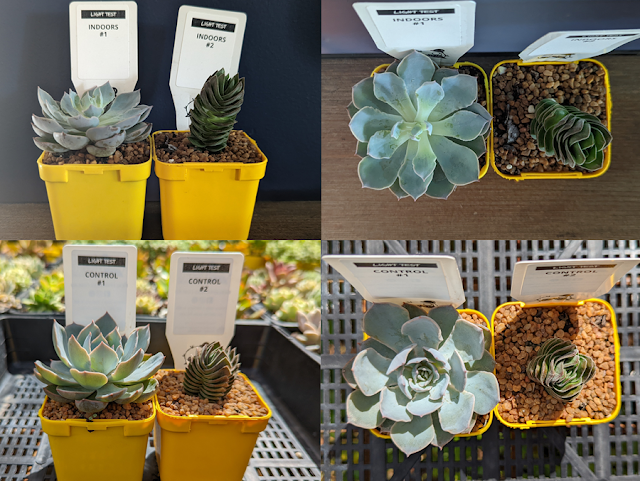
I recently conducted an experiment keeping succulents under various light conditions. 3 identical sets of plants, one set kept in a dark room, one under some artificial grow lights, and one grown as a control in the stable conditions of our succulent nursery. The purpose of the experiment was to provide some side by side photos in order to help point people in the right direction about finding the ideal spot at home to grow succulents.

In part 1 of this story, I discussed the results of the plants grown in a dark room. After 7 days, the succulents starting showing signs of lack of light and by day 12 they looked quite light deprived compared to the control plants. If you would like to view the results of that comparison, and see some tips on how to rectify the symptoms of lack of light in succulents, please head to Part 1: Signs of Lack of Light.

In part 2, I want to talk about the plants I kept under artificial grow lights. Now, I chose to add this to the experiment, because keeping succulents in an indoor location can be impractical if they don’t receive enough light in that room. By adding a grow light to your indoor succulents, you can supplement that indirect light it receives thorough a window, and you can successfully keep a nice, healthy compact plant indoors.

But for how long each day should you have this grow light on for? This is the question I wanted to answer by placing these plants under these lights. And thus, the experiment continues!

Now, if you would like to get into the science of how grow lights work, including the light spectrum, different wavelengths/colours, LED vs incandescent, it’s a big subject you can really sink your teeth into, and I do recommend delving into that rabbit hole if you have time. However for this experiment, I’m keeping it simple – I actually used an aquarium light passed on to me from my partner who really likes to keep fish. I confess, it’s a rather cheap light. I don’t have too many specs on it, only that it is 24w LED, and they are white coloured LED’s. I’ve germinated seeds under this light before and I’m very happy with the results.


THE EXPERIMENT

The Plants

Just as a reminder, the succulents I chose for this experiment were ‘Echeveria Morning Beauty’ and Crassula ‘Buddah’s Temple’. I chose the Morning Beauty because of its bright blue colour, and for its rosette shape, the Buddah’s Temple I chose because its deep green colour, and its upright growth habit.


The Conditions

All the plants were from the same batches – They were the same age, same potting media, same pot size, and had the same watering schedule up until the start of the experiment.

The control plants in this experiment were placed out in the nursery, and they received about 8 hours of sunlight per day. They were under hail net which filters out a small fraction of light. They were watered every day, as I conducted this experiment at the end of summer.

The indoor plants were kept in a room I know to be too dark to grow succulents. Although next to a window, the indirect light was just too filtered to be sufficient for healthy growth. They were watered every second or third day.

The grow light plants were placed inside a glass tank, with the LED bar light about 25cm above them. They were watered every second or third day.

I kept this light on in this tank for 24 hours a day for the duration of this experiment.

The reason why? To see whether there is such a thing as ‘too much light’.  I’ve read up on the idea of light toxicity and the detrimental effect  it can have on plants, and Kaye tells me it does exist (She is the horticulturalist in the family, who am I to disagree…) BUT, I just really wanted to see the results for myself.


THE RESULTS

Day 1


Day 3


Day 7


By day 7 there still weren’t too many differences in the plants – All 4 plants were very healthy. In fact, the Morning Beauty under the 24 hour light was doing far better than I could have expected. The foliage was strong and the rosette nice and compact. No signs of light toxicity at all.

Day 12


It was by Day 12 that I was really impressed. Both plants under the 24 hour light were absolutely thriving. The blue colour in the Morning Beauty was so intense.

Day 15 – The final Comparison


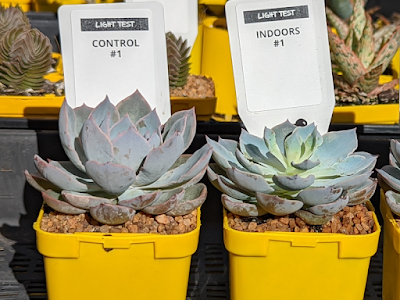
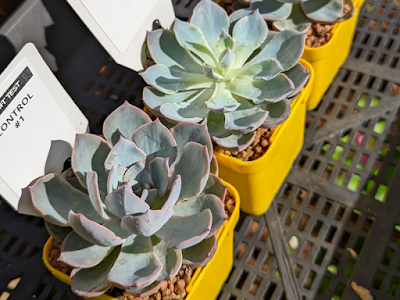
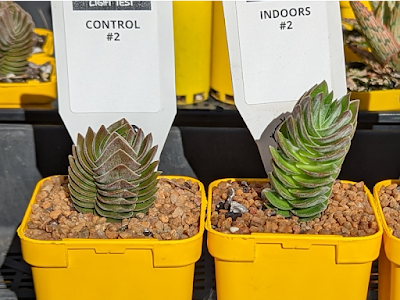
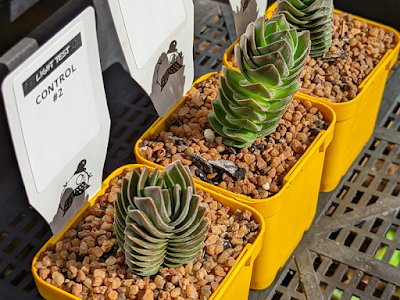
Wow. Very unexpected results. Putting all 6 plants in this experiment side by side to compare made the results very clear. No light toxicity to be seen! The intense blue colour in the Morning Beauty kept under the grow lights is just stunning. The Buddah’s Temple faired well too, however the control is just a tad more sun hardened, you can see that by the bronze colour it shows.

So, if you have succulents you wish to place indoors, in a spot that may be a tad too dark for healthy growth, definitely think about using a grow light. As for how long to keep the light on for each day, I would start at the basic 8 hours of light per day to mimic the sun’s behaviour. You can always increase of decrease it based on the look of your plants. Timers work great so you don’t have to remember to switch them on every day, and I like to offset the 8 hours and run my lights from noon to 8pm, so I can enjoy seeing my succulents all lit up in the evening.


Read Part 1 of this Experiment, How much light do Succulents really need? Part 1 of 2 – Lack of Light


16 March, 2022

How much light do Succulents really need? Part 1 of 2 – Lack of Light

How much light do Succulents need?

How much light do Succulents really need?

It’s a question that is asked quite often, and unfortunately, there is no universal, one size fits all answer. Succulents are a family of plants that originate from all around the globe, from all different types of environments - Tropical, Arid and even Alpine. It’s what makes them so fascinating to grow, as they offer so many different colours, textures and shapes.

The best approach in narrowing down what your succulent may need in terms of light, is to research what area it originates from, and replicating that at home. In combination with that, my best advice is to simply keep an eye on your succulent. If it is showing signs of lack of light, it’s time to make some adjustments.


What are the signs of lack of light in succulents?

To answer this question, at first I wanted to put some succulents in a dark room and take some photos after a week or two to highlight the visual signs of lack of light. Then I thought I should have some ‘control’ plants grown out in our nursery to offer as a comparison. THEN, I took it one step further and added to the experiment some plants grown under artificial grow lights, and you can read all about that in part two of this article coming up next month.


THE EXPERIMENT

The Plants

The succulents I have chosen for this experiment are ‘Echeveria Morning Beauty’ and Crassula ‘Buddah’s Temple’. I chose the Morning Beauty because of its bright blue colour, and for its rosette shape, the Buddah’s Temple I chose because its deep green colour, and its upright growth habit. 


The Conditions

All the plants are from the same batches – They are the same age, same potting media, same pot size, and have had the same watering schedule up until now.

The control plants in this experiment will be placed out in the nursery, and they receive about 8 hours of sunlight per day. They are under hail net which filters out a small fraction of light. They are watered every day, as it is the end of summer.

The indoor plants will be in my living room – A room I know to be too dark to grow succulents. Placed on a side table near a window, you may think that would be sufficient, however on the outside of the window is a rather deep undercover area. So, although there is some light coming in, it is not enough to promote healthy growth (except for my ZZ plant, which I’m pretty sure grows on magic pixy dust and not light, because it is absolutely thriving in that room!). As for watering they will be watered every second or third day, when they start looking a little dry.


THE RESULTS
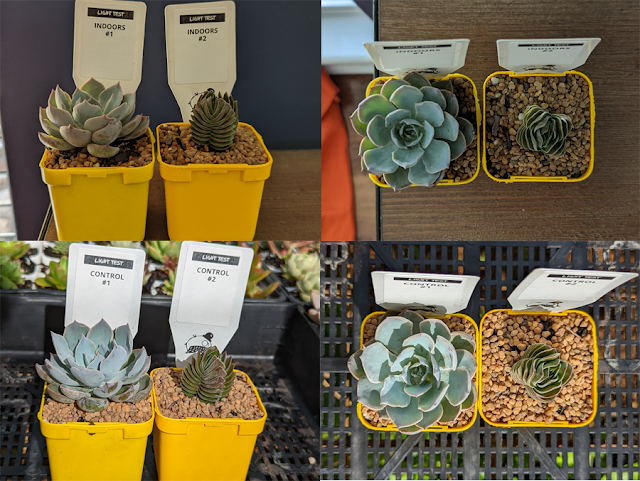
Day 1

Day 1 - Lack of lIght Experiment


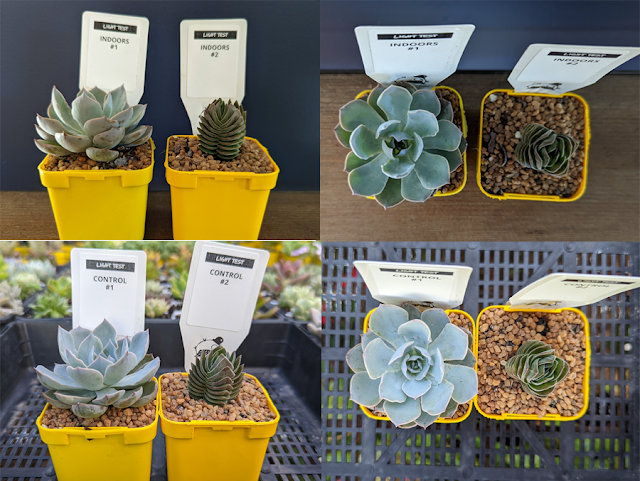
Day 3

Day 3 - Lack of light Experiment


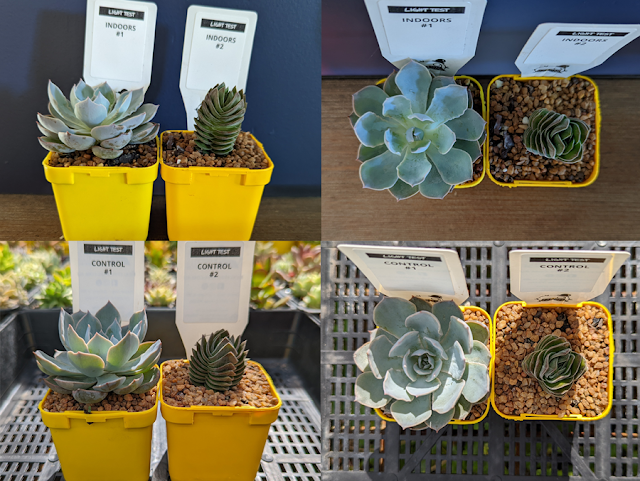
Day 7

Day 7 - Lack of light Experiment


On day 7 you can see that the indoor Echeveria is starting to lose its colour towards the centre of the rosette. The Crassula is growing a little elongated as it reaches for light, and It is also starting to get a little pale in colour.


Day 12

Day 12 - Lack of light Experiment


By day 12 the Echeveria has lost more colour from the centre, and is flattening its shape compared to the control. The Crassula is much taller than the control now, and you can start to see the leaves flattening out, similar to the Echeveria.  The leaves on the control Crassula by comparison remain nice and compact.


Day 15 – The Final Comparison

Day 15 - Lack of light Experiment

Day 15 - Lack of light Experiment

Day 15 - Lack of light Experiment

Day 15 - Lack of light Experiment


As you can see, the differences are quite stark side by side on day 15, the last day of the experiment. The Crassula fared much better indoors than the Echeveria, and that’s due to its green colour which makes it more tolerant of low light conditions.


Signs of lack of light to watch out for:

Lack of colour in the foliage
Elongated growth
Flattening of rosettes or the separation of leaves
Leaves becoming soft, and sponge-like.


What can I do about it?

If you start seeing these signs in your succulents, it may be time to relocate them. You can give them the best chance to get healthy again with a few simple tips:

1. Try not to put them into a bright sunny position straight away, as this can shock them and they will go downhill quite quickly. A gradual introduction of more light is the way to go. 

2. Avoid watering too often during this period – This especially applies to rosette types, as an intake of too much water could cause them to rot.

3. Don’t fertilise a sick plant – This generally applies to most plants, not just succulents. Wait until you see some fresh healthy growth to apply a fertiliser.

4. Prune if you can – This applies to upright types, if you cut back the elongated growth, new growth will shoot away and you should start to see a nice compact plant.

5. In the case of the Echeveria, it may be too far gone to save that one rosette, BUT you may find that it will pup because it is in a stressed state. Those pups will send down roots and grow to fill up the pot space.


I hope this article points you in the right direction about finding the ideal spot in your home to grow succulents. Hopefully it will help you identify signs of lack of light, and what you can do to help them out.  In our next newsletter, we will have part 2 of this experiment, which deals with the idea of ‘too much light’, as well as growing succulents under artificial grow lights.


Read Part 2 of this experiment: How much light do succulents need? Part 2 – Is there such a thing as too much light?


01 February, 2022

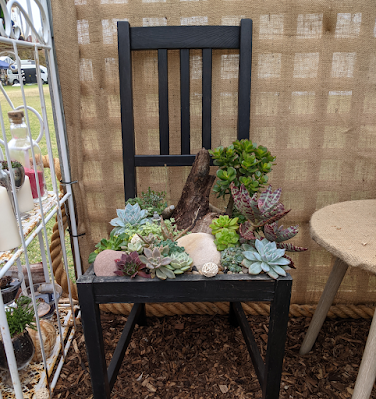
Garden ART: Old Chair to Charming Succulent Planter!

Cactus Chair

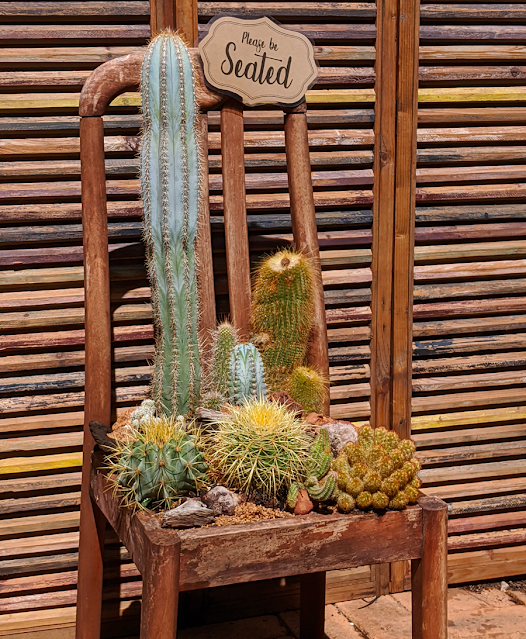
Have an old chair sitting around the house gathering dust? Well, why not UPCYCLE it into a charming succulent planter and create a unique feature for your garden that will be a talking point for all of your visitors. 

Chairs are plentiful at op-shops, recycling centres and road side collections, and they are often made of hard wood, which means a strong sturdy base that will tolerate both water and sunlight. A breezy weekend project, a succulent chair like this will look fabulous in all garden sizes, even the smallest of patio spaces.


Preparing the Chair:

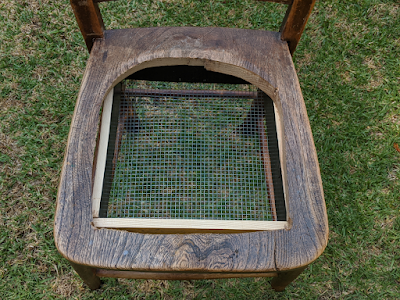
Creating a Hole – Some chairs come with a padded seat, that when removed reveal a perfect frame to plant into. Other chairs will require a hole to be cut in the seat. This extra step can be advantageous, as you can cut the hole to any size or shape – circular, square, curved at the back. Cut as much or as little of the seat away as you desire.

Building Depth – The deeper the planter box is in the chair, the more established the roots of your plants can become, extending the life of your display. And again, some chairs come with a perfect frame that’s a good 5cm – 10cm deep. But if this isn’t the case, you may need to add a wooden frame to the bottom of the seat to create some depth. If you’re not the best at DIY wood work, don’t be afraid! It doesn’t have to look super neat; you won’t see much of the frame once it is all planted up.

Succulent Chair Hole

Attaching a Bottom – We stapled wire mesh to the bottom of our seat’s frame. Mesh is ideal to use in this circumstance, as it allows water to drain freely. Don’t worry about your potting mix falling though just yet - We will cover that shortly.

Attaching mesh to the hole

Styling – You can paint your chair in a vibrant colour, or keep it natural like we have done. Shabby chic is popular right now, and is very easy to accomplish by painting on a colour and then sanding it half away. A coat of sealant will protect the wood and make it last longer, but isn’t entirely necessary if you don’t have the time.

Succulent Chair hole and frame


Planting it up:

Moss – Place a layer of sphagnum moss in the bottom of your frame. This will prevent potting mix falling through the mesh. Sphagnum Moss comes in dehydrated bricks and to prepare it, simply soak it in water for 10 to 15 minutes.

Potting Mix – Next, fill with a good quality, free draining cacti and succulent potting mix. Use large natural objects like rocks, logs or drift wood to create height in your base, and then fill in the spaces between with your mix.

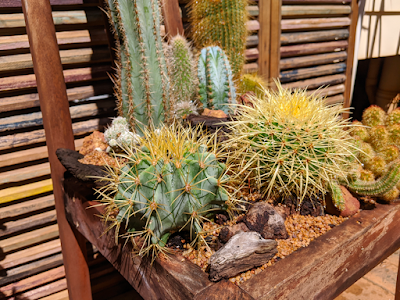
Plants – Start by planting the largest feature plants first and work your way down to the small fillers. Combine succulents with similar colours and shapes for a classic, sophisticated design, or play with different colour and shape combinations for a more eclectic look. We have planted ours out entirely with Cacti – Taller ones at the back and squattier ones at the front. We also used a small log as a retaining wall in the middle to give the back section more height.

Cactus Chair

Mulch - Once you are happy with the design, water in the plants before applying a topping of gravel or small pebbles. A topping like this helps insulate the roots from intense heat or cold and prevents the mix from drying out and becoming water repellent. It is also helpful in securing plants into place, and preventing soil erosion. Water thoroughly a second time to allow the gravel to settle.

Succulent Chair


Maintenance:

Sun - Keep your chair in a nice, bright spot. Avoid direct sunlight in the afternoon and on days where the temperature is over 38 degrees. 

Succulent Chair

Water - Water thoroughly every couple of days when the weather is mild. Water more often in the hotter months and cut right back during winter.

Pruning and Fertiliser - Prune the foliage every so often to keep the plants nice and compact, and remove any dead foliage. Fertilise with a control release fertiliser as directed.

Cactus Chair - PGF2021

This is our cactus chair as part of our SPELLBOUND display at the Perth Garden Festival 2021. The sign reads: "Complaints department - Please take a seat..."


18 January, 2022

Succulent in Heatwaves - Top Questions Answered


It seems that summer has now officially arrived, albeit a little late to the party.

The mild start to the season was a delightful treat to everyone and their plants. Then, it seemed without notice, we were blasted into the high 30's and low 40's before we knew it - A lovely Christmas present to us all.

Up in the hills here, we actually lost power for two days over Christmas. This meant our reticulation system was out for the count and we were forced to halt the celebrations to hand water our plants. Oh, the sacrifices we make for the plants!

How did your succulents fair in the heat wave? Are you prepared for the next one?

As we head into the second month of summer (and it seems like the hot weather is here to stay), we thought we would answer some frequently asked questions we are receiving lately about caring for succulents in the heat.


How often should I water during Summer?

One old fashioned rule is to 'water when the soil or mix becomes dry'. I'm not the biggest fan of this rule, as you don't actually want the soil or mix to completely dry out - This will make it become water repellant. When you do get around to watering, the water will sit on top of the soil/mix for a second or two, and then run off to the side, away from the base and roots of the plant. 

If this is the case with your mix, don't fret, it can be corrected - You can use a soil wetting agent to improve water penetration. They come in liquid form and a granular form ( I prefer the granules, you can sprinkle over as needed with ease).

A more modern take on this watering guidline is 'Water when the soil or mix is NEARLY dry'. A little less than damp. But how often is that?

Well, it does depend on a bunch of different factors - Plants inside will need watering less often, as will those in shadier positions in the garden. On the other hand, those plants in pots (especially smaller ones) could be watered once a day in the summer months, as could plants in sunnier positions. Learn to listen to your plants, and look for the signs of dehydration - Wilted or sagging leaves, rosettes shrinking and closing up, loss of colour and brown leaves.

An Echeveria 'Domingo' with heat stress.

An Echeveria 'Domingo' showing signs of heat stress - the rosette has closed up and the leaves are wrinkled and turning brown.

Aloe striata showing heat stress

An Aloe striata in the garden that is suffering in the heat. The rosette has closed up and the leaves are browning and curling.


How can I stop leaves from burning?

There are a few temporary measures you can take to help protect your succulents from burning in the sun if you know the temperature is going to go up past, say, 38 (ish) degrees.

The first is temporary relocation - If your plants are in pots, and you are able to move them, the best option is to place them somewhere for the day, or a couple of days, where the sunlight isn't shining directly on them. Under a verandah or patio is perfect. Ideally, somewhere where they can still receive plenty of indirect sunlight.

The second option is a temporary shade sail, such as shade cloth. The key to creating a great temporary shade sail is airflow. Lift the shade cloth up with stakes as much as you can and avoid having the shade cloth touching the foliage. If it's quite low to the ground, it can create an environment too humid for succulents.

After a couple of days of being under shade cloth, your succulents can start to become leggy and green, so it's not really an ideal situation for the whole summer season, but the perfect temporary solution for those extreme days.


When should I water my succulents?

If possible, try to water your succulents in the cooler times of the day - Either early in the morning or late afternoon. The reason for this is that it can be the combination of water and heat that causes rot in your plants. Sometimes the water can pool on the foliage, especially in the case of rosette type succulents. This pooling creates a 'magnifying glass effect' with the sunlight, which can cause sun damage.

Remember to water succulents thoroughly, so they can develop a lovely strong, deep, root system. This gives them the best chance to defend themselves against the heat.


For the most part, succulents are very water wise, and generally very tolerant of the heat. But during those times where temperatures start getting above 36/38, and especially for an extended period of time, we need to provide them with just a little more TLC so they can get through the season.

05 June, 2019

Keeping Succulents Indoors - A How-to Guide


Choosing Plants:
Opt for succulents that can tolerate low light conditions. Green coloured succulents tend to be low-light tolerant, and are more successfully grown indoors. Succulents with bold, bright colours tend to require more light than an indoor position can offer. These succulents are better suited to outdoor applications in a full sun/part shade aspect.

Haworthia and Gasteria species make fabulous indoor succulents, and then there’s the old classic Mother-in-Law's Tongue, or Sansevieria (pictured), that is an almost indestructible indoor plant.

Choose trailing succulents for indoor hanging baskets or macramé hangers – Succulents like String of Pearls (Senecio rowleyanus), String of Beans (Senecio herreanus) and Rhipsalis species are the perfect choice for indoor hangers.

Browse for low-light tolerant plants in our online store - Fickle Prickles.


Potting Mix:

Always plant succulents into a good quality, cacti and succulent potting mix. Simply put, cacti and succulent potting mix is more ‘free draining’ than regular potting mix, and this helps to keep your succulent’s roots from rotting.

To further improve the drainage of your mix, you can add perlite at a ratio of 1 part perlite to 4 parts succulent mix.


Containers:

Pots with drainage holes are best. If they have saucers, that is perfectly fine, just be sure to empty them after each watering. Succulents don’t like having wet feet for extended periods of time.
If you have containers without drainage, including glassware, there are two potting methods you can try:

1. Expanded clay


Expanded clay is available at some nurseries and most hydroponic retailers. To use it, simply rinse to clean and fill up your desired container. Put a small piece of charcoal in the bottom to filter the water. Rinse your plants of any soil and plant into the expanded clay. Read more about Potting Succulents into Glassware using Expanded Clay on Succulent ART's website.


2. The Charcoal Method


This method works for both terrariums as well as any container in general that lacks drainage. It involves layering a container firstly with charcoal, then sphagnum moss, and then cacti and succulent potting mix. The moss prevents the potting mix falling into the charcoal layer, and the charcoal layer helps keep the water clean. Read more about Potting Succulents into Containers without Drainage on Succulent ART's website.

There’s also the ‘pot cover’ technique, where you keep your succulent planted in its plastic pot, and you then place that inside a decorative pot cover that has no holes. This allows you to take the plant out of its cover every time it needs watering. Very handy.


Light:

Certain plants require more light than others. Some need to be near a window with a significant amount of light, some need to be near a window but will require less light, and some (such as Sansevieria) can tolerate being in the centre of a room with a little amount of light.

The general rule of thumb for succulents is 6 hours of indirect sunlight per day. Remember the sun sits higher in the sky during summer, and lower in the sky during winter, so what may work perfectly in one season, may not in the next. Play around with positions until you find what works best for your succulent.


Water:

1. For containers with drainage holes – Firstly, be sure to water them thoroughly; that is, until the water falls freely out of the bottom. After this, allow time for the water to drain and then put your plant back into place. Try to avoid having water sitting in a saucer by emptying them regularly.

Secondly, allow the mix to almost dry out before the next watering. I’d love to give you a specific schedule, but it is really dependant on the plant and its position. Once a week is a good starting point. More often in Summer, less often in Winter. Remember the rule –Water more, less frequently.

2. For containers without drainage holes - If you are using the expanded clay method mentioned above, keep the water level to no more than one third the way up the container. For the charcoal method, keep the water level to below the moss layer. This will still allow the roots (though capillary action) to receive water without them actually sitting in any water.


Fertiliser:

Use a control release fertiliser once a year, preferably in spring, just before their main growing season. You can also use liquid fertilisers, but dilute the solution to approx half strength.


Learn to listen to your plants:


  • If they are losing their colour and turning dark green, they may need more light.
  • If they are shrivelling and wrinkling, they may need more water.
  • If they are softening and going squishy, they may need less water.
  • If they are growing elongated, they may be reaching for the light. Prune them and place in a brighter spot.
  • Dropping leaves – All succulents lose leaves during their growth cycle. Dead leaves don’t necessarily mean a sickly plant. A healthy succulent will tend to drop its lower leaves, and grow new leaves from the top/centre.


Have fun and experiment!

The great thing about succulents is their ability to ‘hang in there’ until you have time to care for them. You can, in most cases, bring a succulent back to health that is looking worse for wear, giving you the perfect chance to experiment and learn what works and what doesn’t in your particular situation.

Don’t let them get you down if they don’t make it! Temporary plant displays are just as fantastic as long term ones, and will probably cost you less to setup that most cut flower arrangements.
So get to it! Plant up your living room, kitchen, or office and increase your plant/life balance!

05 September, 2018

How to revamp your potted succulents this spring


Spring is here!
Now that the warm weather is on its way, our succulents will be waking up from their sleepy winter and starting to grow. Spring is the start of their prime growing season (well, most species anyway) and is the perfect time to give some attention to those sad looking succulent pots.

Now is the time to weed - Don't sigh, you know it's time... Pull out all those bubba weeds that have shot up. Do it now, before those pots become more weed than succulent. Your plants will thank you for it.

Tidy up - Remove any dead or rotting leaves. This is especially true for your rosette types (Sempervivum/Echeveria) that grow from the centre out and have old, rotting leaves on the outside and underneath the rosette. It's important to remove these to promote new growth and ensure the rot wont spread to the main plant.

Re-pot if necessary - Spring is the perfect time to re-pot those succulents that have been sitting in the same potting mix for several years, or those who's potting mix has collapsed to well below the lip of the pot. Applying a fresh mix is a great way to give your plants a new lease at life, you will be providing them with an abundant source of nutrients, and it will also help with the drainage of your potted succulent, as that old mix has probably become a little water repellent over time.

Now is the time to fertilise - Speaking of nutrients, now is the perfect time to re-apply that control release fertiliser. You can also apply a seaweed or blood and bone solution to give your plants a kick start to spring.

Mulch - Mulch isn't just for the garden. Potted succulents will benefit just as much from a good layer of gravel. Not only does it make the plant 'pop' and look absolutely stunning, it also helps prevent water evaporation from the soil. It provides the roots insulation from the suns rays, which is vital in WA's intense summer heat.

Sun - Spring is the main growing season for most succulents. So make the most of it! Make sure your potted plants are receiving a decent amount of sunshine. Place them in a well lit area and they will burst into life.

06 July, 2018

Succulents and Frosts


We are very fortunate here in Perth to not experience frequent frosts during winter. But that doesn't mean they can't happen - This photo above was taken in July 2015 when the temperatures dipped to below freezing just after the sun rose. It was only for a very short period of time, and it only dipped a little below 0, but still, you can see the effect it had on my poor oregano plant!

Very pretty, but also pretty devastating if you have succulents. Why is that? Succulents retain water in their foliage, which is what gives them their fleshy look. This is what freezes when the temperatures dip. Some succulents are more prone than others - The more 'fleshy' the foliage, the more susceptible they are. Species of Sempervivum, for example, have thinner, tougher leaves. They originate from Alpine regions and can tolerate frosts easier than say, species of Echeveria, with their juicy, plump foliage.

How can you protect your succulents from frost damage?

It is relatively easy to protect your succulent babies from being damaged by frosts, all it takes is a little planning and forward thinking. Like I said, we are lucky to not have below freezing temperatures for very long, and at worse, we generally only see temperatures of -1 or -2, so little changes can make a big difference.

Succulents in Pots:

Pick them up off the ground. Frosts tend to rise from the ground no more than say half a meter, so simply by placing your pots on a table or plant stand, you may have done enough to protect them already.

Minimise their exposure. This can be done by placing them under a verandah or patio instead of outside in the elements. Placing your pots near the walls of your house is also great.

Insulation. Mulch your pots with pebbles and/or gravel. Whilst it may seem like this will only protect the soil and roots of your succulent and not the foliage, stones will retain heat from the day longer than just bare soil. Having your foliage in close proximity to this 'insulation' will help prevent the immediate air around your pot plant from dipping that one degree below zero and generating icicles on your foliage.

Succulents in the Garden:

Gardens are a little trickier to protect, as you cant just 'relocate' them until the weather improves like you can with pots. However the same sort of principles do apply.

Mulch your gardens. As mentioned above, mulching will help keep the immediate air around your plants that little bit warmer than just bare soil.

Plant in mass. A singular plant on its own is exposed in all directions to the cold. Plant in mass and they will create a little eco-system of their own and help keep each other warm. Like you see the penguins do when a blizzard comes!

Use masonry in your landscape design. Sculptures, statues and even large rocks are all perfect at absorbing the sun during the day and cooling down slowly at night. Plant your more susceptible species near these features and it will provide them with protection from the cold.

I hope these tips help you protect your succulent collection from the frosts this winter and get them through to the warmer weather in spring.